

Why Your Website Matters More in the Age of AI
Clicks from organic search are down (way down). Social media used to drive traffic, but now the algorithms don’t like your links and keep people from leaving those platforms. Plus, nearly everyone’s using LLMs to get answers lately.
What’s the point of having a website anymore? Is owned media still worth producing?
We get the feeling. The game has changed. But that doesn’t mean that giving up on your website is the right move.
It’s time to adapt to the new rules and shift the way you think about marketing, so your website will become even more valuable while your brand becomes more visible.
What happened to your website traffic?
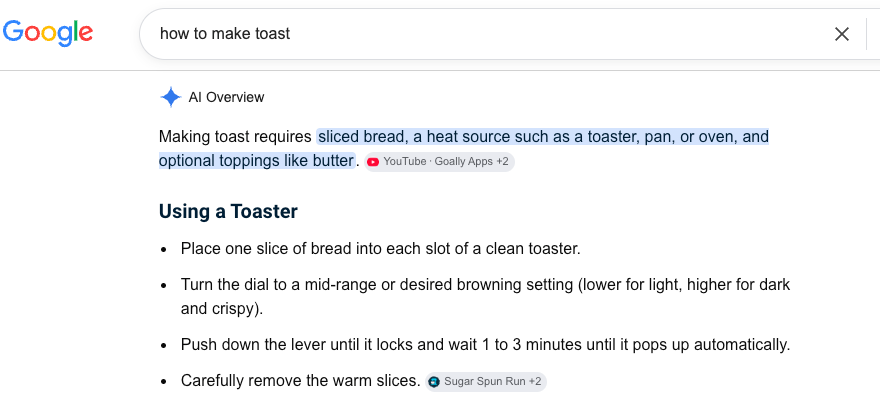
People are still searching for answers online. Google has more users than ever. But they aren’t clicking through from the SERPs like they used to. As many as 60% of Google searches don’t produce a click. AI Overviews (AIOs) conveniently give us quick and easy answers to everything from the best software options to how to make toast.
Meanwhile, LLMs and AI search tools like ChatGPT, Claude, and Perplexity are transforming the ways we learn and make discoveries online. That often means stealing traffic that used to go to websites and company blogs.
This has hit especially hard for B2B brands that relied heavily on organic search to distribute informational content. Large-scale studies from Ahrefs and BrightEdge found that organic click-through rates declined by roughly 30–35% as AI Overviews expanded.
People haven’t stopped asking the same questions as before. They’re just finding the answers in new places. It’s convenient for them, but a big problem for B2B content marketers.
A Responsive survey found that 80% of B2B buyers working in the technology industry used generative AI at least as much as traditional search when researching vendors.
If your website feels like it’s dying, or at least on life support, that’s understandable.
But it’s not over. We believe your website is ready to rise from the ashes and make a real difference for your customers, prospects, and business. There are plenty of signs of life proving that websites are more important than ever.
The homepage is making a comeback
At some point, we stopped thinking about the homepage as the “front door” of a website. The traffic that search and social media used to send meant that nearly any page could be the first a new visitor saw on your site.
A few years ago, when you checked out website performance analytics, you likely saw that a couple of optimized blog posts and maybe a landing page or two beat out the homepage as top traffic earners.
But the homepage is returning to its original glory. It’s once again becoming the first way people experience your business and brand on your terms. AI search is driving this change.
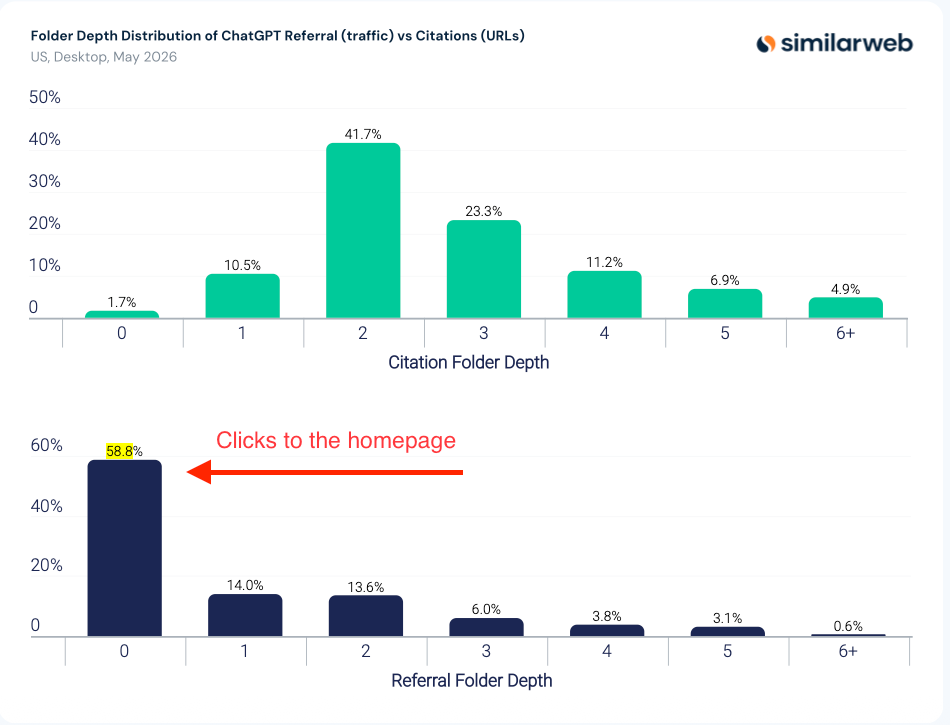
Similarweb’s recent analysis found that ChatGPT is more likely to cite deeper pages as sources, which makes sense. Homepages have the basics while landing pages, articles, and support documentation have the details that make for solid citations.
But ChatGPT users don’t seem likely to click through to those deeper pages. Similarweb found almost 60% of ChatGPT referral traffic goes to homepages.
If you’re optimizing for AI search, you should also be optimizing your homepage experience for visitors from LLMs. That includes everything from copy and layout to the main call to action.
The homepage is the point of entry once again. It’s a launching pad for how people learn about your business after AI answers, social proof, and other external forces push them to check out your site for themselves.
Your website is a source of truth
Human visitors will head to your website to get confirmation and clarification, but you need to take those machine visitors into account as well. Similarweb’s research suggests that AI platforms are searching the live web for answers more often. The chance of earning a citation remains pretty low, but it’s growing.
While still small in comparison to search, AI referral visits tripled between September of 2024 and September 2025. The analysis also found that, in May of 2026, close to 7% of ChatGPT answers in the U.S. contained at least one citation linking to a website.
Your website is the ultimate authority and source of truth on your products, services, and brand. When AI needs to confirm something for a user, it’ll visit your site. People will do the same and so could journalists, partners, and existing customers or users.
That’s why your site should provide a clear articulation of who you are, what you do, and who you serve.
The click is moving down the funnel
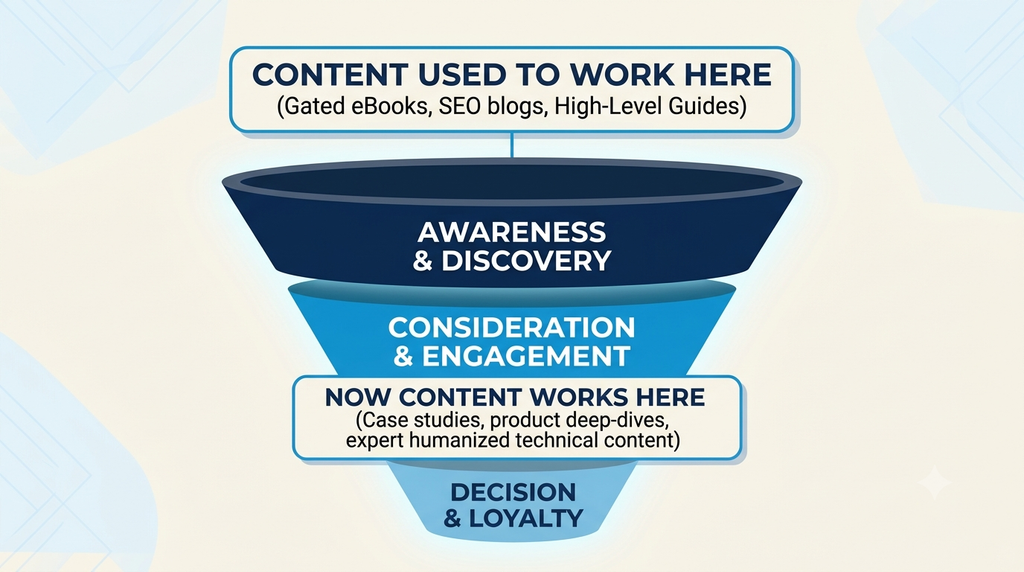
Much of what content marketing used to focus on was built around the Awareness stage of the buyer’s journey, near the top of the funnel, if not a bit outside of it. That’s changed with AI.
Now, much of that segment of the buyer’s journey can happen before someone sees a single page of your website.
Google’s AI Overviews and LLMs can offer quick answers, while conversations between humans and LLMs go deeper. Social posts, videos, newsletters, online communities, and review sites add more information along the way.
Your website’s primary goal is no longer to attract traffic. It’s to convince and convert people who’ve been primed and prepped on shared, earned, and paid channels.
There’s still room to educate, but more of the effort and strategy needs to move down the funnel. That means shifting more of your owned content to where buyers are evaluating options, looking for proof, and resolving their final concerns.
You may get fewer clicks to your website, but when people do click through to your site, they’re doing so with real intent. Those visitors are going to be curious, qualified, and motivated. They’re visiting the site because they’re interested, not because of a clickbait headline.
Your website doesn’t need more basic definitions to educate potential buyers. Those prospects want to verify what they’ve heard, see whether your offering fits their needs, and decide whether your company belongs on the shortlist.
Build a home for the brand
“Do people like me work with companies like this?” That’s one of the most important questions prospects ask themselves before they make a decision. And the answer depends heavily on your brand.
What people encounter early in their journey will only begin to paint that picture. When they actually visit your website, that solidifies what they think, feel, and believe about your business.
That perception is your brand. You need your own corner of the internet to influence those beliefs about your business.
A website gives you space to connect your positioning, expertise, products, people, customer stories, and point of view into one coherent experience. Instead of relying on an algorithm to choose which part of the brand someone sees, you can show visitors how everything fits together and guide them towards conversion.
Likewise, design, navigation, speed, accessibility, imagery, and the overall feel of your site all shape how people perceive your company. A strong website experience reinforces the trust created by a recommendation from AI, a review site, or social media.
Your website should help you close deals. But if you neglect to invest in it, the opposite can happen. A less-than-stellar website experience will sour prospects on your brand.
Your website and the quest for AI search visibility
Humans aren’t the only ones who will keep using your website to understand your brand. It’s also part of the information that AI systems use to understand what your company does, what it knows, and when it belongs in an answer.
We won’t rehash the basic best practices for AI search like chunking content, using Schema markup, and answering the question near the top of the page. Instead, let’s take a look at the big picture.
Owned content is an important foundation for AI search visibility. But simply publishing more content won’t make AI systems recommend you. That’s especially true when you just republish information that’s already in AI’s training data. Then, it doesn’t need to visit your site.
This is why Google’s concept of “non-commodity” E-E-A-T content should be your guiding light. It stands for Experience, Expertise, Authoritativeness, and Trustworthiness. This kind of content is harder to produce, partly because it almost requires keeping humans (not AI) central to production.
Don’t view AI search visibility as an effort to manipulate LLM responses. That’s a slippery slope. Your goal is simply to make your expertise easier to find, understand, and verify, while keeping content connected to the questions your audience is asking.
AI search is more complex and constantly changes
In the days before AEO and GEO, when SEO was the main thing content marketers took into account, it was easier. You only had to worry about optimizing for Google because it dominated the search market. But AI search works differently because each LLM works differently.
Research from AirOps found that only 13.2% of brand mentions across its commercial-discovery prompts came directly from brand domains.
In a separate study focused specifically on Claude citations for SaaS and technology queries, Otterly.ai found that brand sites accounted for 64% of citations. But Otterly.ai also found only a 13% overlap between the domains cited by Claude and ChatGPT.
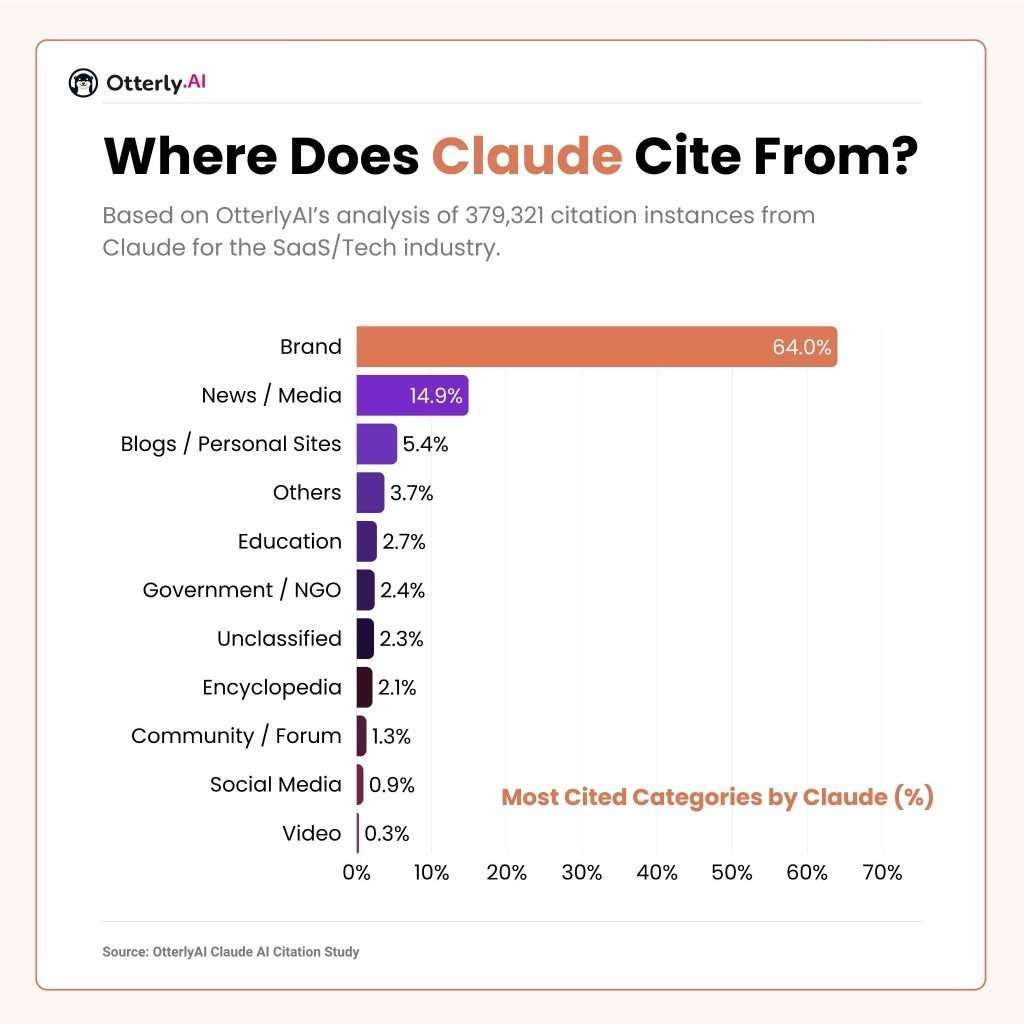
The studies aren’t directly comparable, but that’s part of the point. Results change depending on the model, audience, query type, and methodology.
By the time you read this article, there will be new studies on AI search visibility, updated best practices, and plenty of hot takes.
Chasing every new “ranking factor” or citation study will keep your marketing team busy, but it won’t necessarily build lasting visibility. Investing in your website, however, certainly could.
Where to focus content marketing efforts now
First, understand that there’s very little value in repeating or reworking the kinds of generic articles that already populate the web.
Focus on what remains useful across platforms: a clear, credible website filled with original information, firsthand expertise, strong proof, and consistent signals about what your company should be known for. That includes:
- Content driven by thought leaders and subject matter experts (SMEs)
- Original research and benchmarks
- Case studies and customer stories
- Up-to-date support documentations
- FAQs that answer the questions your prospects actually ask
- Industry analysis and testimonials
You may not control how an LLM describes your brand. But with a well-designed site full of the right kinds of content you can give it better material to work with.
Blue Ivory isn’t giving up on websites, and neither should you. We help brands build out their content marketing roadmap and offer website design and development for industries including wholesalers, waste management, tourism, and non-profits.
Check out our portfolio of WordPress websites to see some of our work.


